RambergOsgood
Ramberg-Osgood Steel Model
Syntax
| Text Only | |
|---|---|
History Variable Layout
| location | value |
|---|---|
initialize_history(0) |
load_sign |
initialize_history(1) |
reverse_strain |
initialize_history(2) |
reverse_stress |
initialize_history(3) |
previous_reverse_strain |
initialize_history(4) |
previous_reverse_stress |
Remarks
- Local iterations are required to obtain the stress value.
Theory
The Ramberg-Osgood relationship is defined as
\[
\varepsilon=\dfrac{\sigma}{E}+\alpha\dfrac{\sigma}{E}(\dfrac{\sigma}{\sigma_0})^{n-1}
\]
where \(\alpha\) is the offset and \(n\) is the material constant controls hardening. Noting that \(\varepsilon=\varepsilon_e+\varepsilon_p=\dfrac{\sigma}{E}+\varepsilon_p\), hence
\[
\dfrac{\sigma}{E}+\varepsilon_p=\dfrac{\sigma}{E}+\alpha\dfrac{\sigma}{E}(\dfrac{\sigma}{\sigma_0})^{n-1}
\]
so
\[
\varepsilon_p=\alpha\dfrac{\sigma}{E}(\dfrac{\sigma}{\sigma_0})^{n-1}.
\]
At the yield stress, viz., \(\sigma=\sigma_0\), then
\[
\varepsilon_p=\alpha\varepsilon_e.
\]
So the offset \(\alpha\) indicates the magnitude of plastic strain at yield stress.
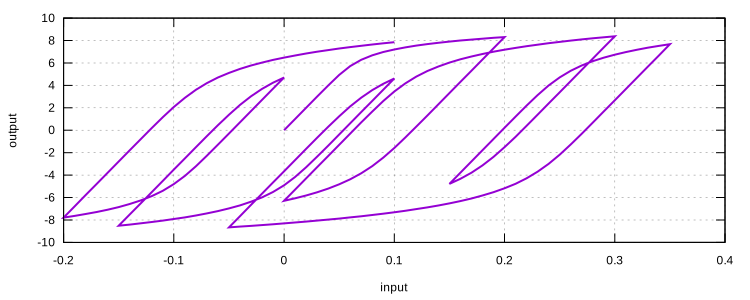
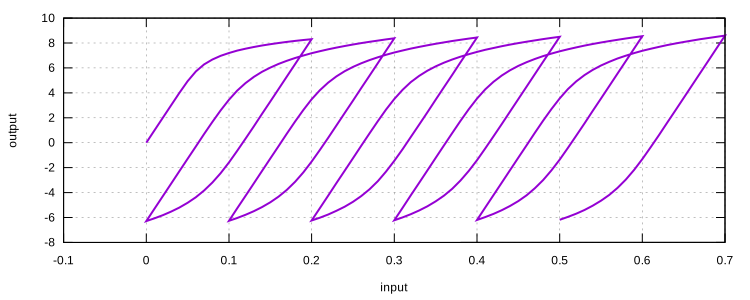
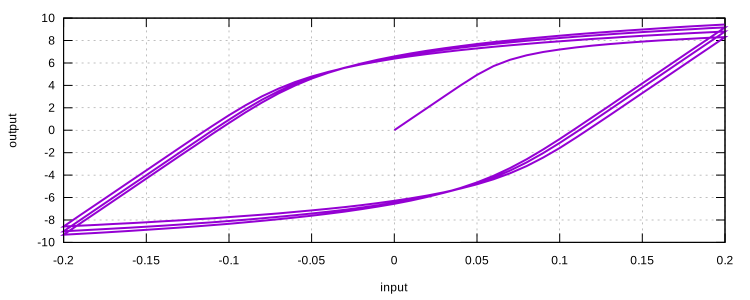
The cyclic response uses the difference between current reverse stress and previous reverse stress as "yield stress".
Examples
| Text Only | |
|---|---|
| Text Only | |
|---|---|
| Text Only | |
|---|---|