ExpGurson
See also the corresponding section in Constitutive Modelling Cookbook.
References:
- 10.1002/nme.1620240713
Syntax
| Text Only |
|---|
| material ExpGurson (1) (2) (3) (4) (5) [6] [7] [8] [9] [10] [11]
# (1) int, unique material tag
# (2) double, elastic modulus
# (3) double, poissons ratio
# (4) double, initial yield stress, \sigma_y^0
# (5) double, n
# [6] double, q1, default: 1.0
# [7] double, q2, default: 1.0
# [8] double, fn, default: 0.0
# [9] double, sn, default: 1.0
# [10] double, en, default: 0.0
# [11] double, density, default: 0.0
|
Theory
The yield stress is governed by the following implicit function.
\[
\dfrac{\sigma_y}{\sigma_y^0}=\left(\dfrac{\sigma_y}{\sigma_y^0}+\dfrac{3G}{\sigma_y^0}\varepsilon_m^p\right)^n.
\]
Note we are using a slightly different notation compared to the one presented in 10.1002/nme.1620240713.
Due to that the yield function has the quadratic term \(q^2\), it shall be noted that the unit of the model shall be
selected carefully. For example, if the yield stress is \(1000~\mathrm{MPa}\) and \(\mathrm{Pascal}\) is used as the
unit for stress, then the input number is \(10^9\), the square of which is greater than \(10^{16}\) so that the yield
function likely overflows.
Iso-error Map
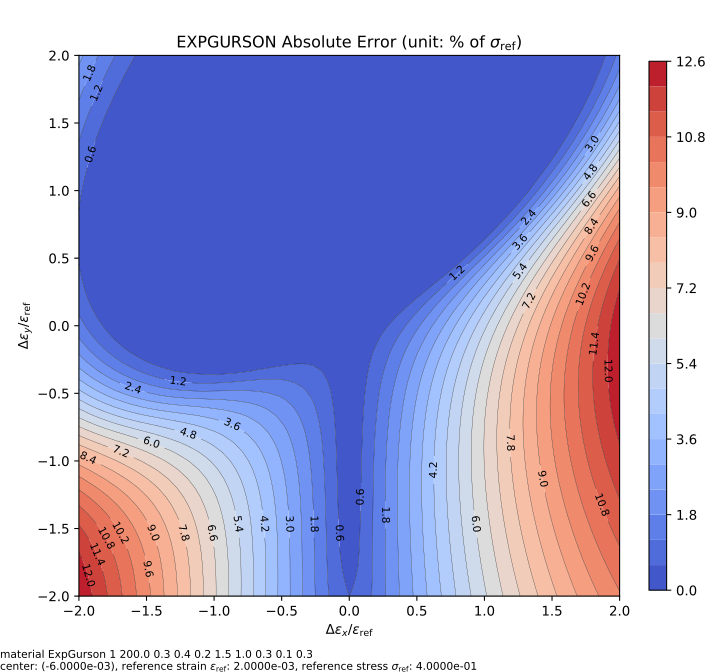
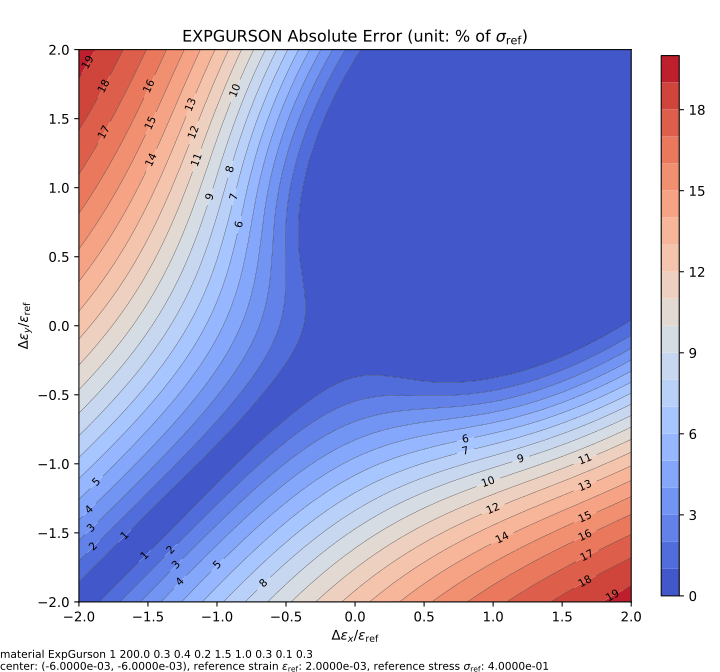
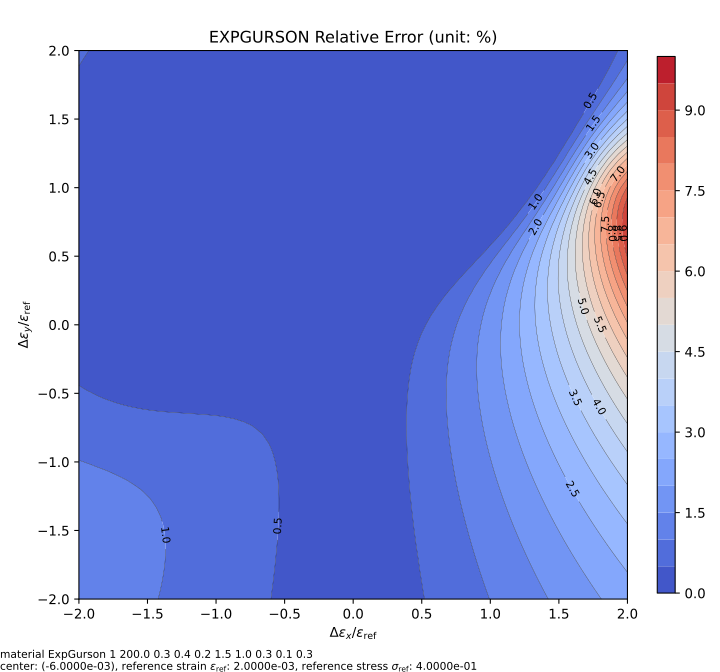
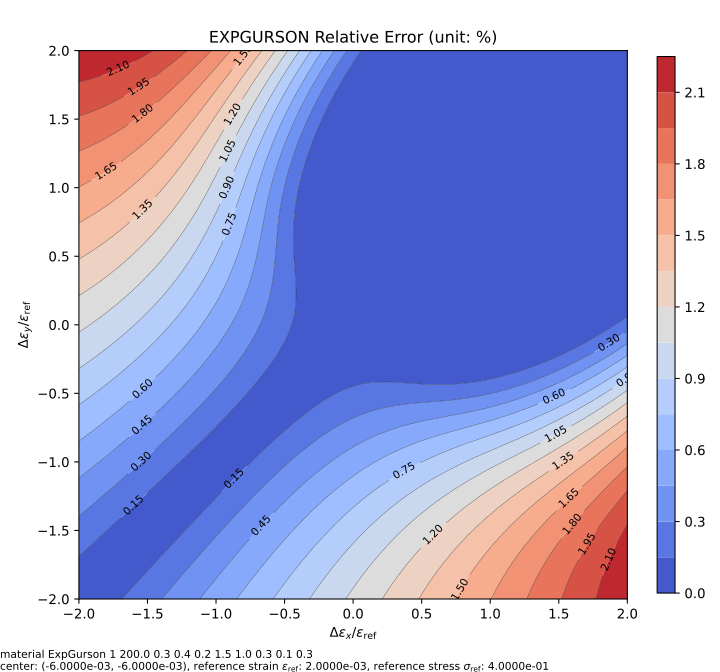
The following example iso-error maps are obtained via the following script.
| Python |
|---|
| from plugins import ErrorMap
# note: the dependency `ErrorMap` can be found in the following link
# https://github.com/TLCFEM/suanPan-manual/blob/dev/plugins/scripts/ErrorMap.py
young_modulus = 2e2
yield_stress = 0.4
with ErrorMap(
f"material ExpGurson 1 {young_modulus} 0.3 {yield_stress} 0.2 1.5 1.0 0.3 0.1 0.3",
ref_strain=yield_stress / young_modulus,
ref_stress=yield_stress,
contour_samples=30,
) as error_map:
error_map.contour(
"exp.gurson.uniaxial", center=(-3, 0), size=2, type={"rel", "abs"}
)
error_map.contour(
"exp.gurson.biaxial", center=(-3, -3), size=2, type={"rel", "abs"}
)
|