SteelBRB
Steel Model For Modelling BRB
The SteelBRB material defines a steel model. It can be used to model buckling restrained braces. It uses exponential
type functions thus resembles the RambergOsgood material.
References are available:
- https://doi.org/10.1016/j.jcsr.2011.07.017
- https://doi.org/10.1016/j.jcsr.2014.02.009
Syntax
If tension response is identical to compression response, users can use the following command to define the material.
| Text Only |
|---|
| material SteelBRB (1) (2) (3) (4) (5) (6) (7) [8]
# (1) int, unique material tag
# (2) double, elastic modulus
# (3) double, yield stress
# (4) double, plastic modulus
# (5) double, saturated stress, \sigma_s
# (6) double, \delta_r
# (7) double, \alpha
# [8] double, density, default: 0.0
|
If tension response is different from compression response, which is often the case in modelling BRB, users can use the
following command.
| Text Only |
|---|
| material SteelBRB (1) (2) (3) (4) (5) (6) (7) (8) (9) (10) [11]
# (1) int, unique material tag
# (2) double, elastic modulus
# (3) double, yield stress
# (4) double, plastic modulus
# (5) double, tension saturated stress
# (6) double, tension delta_r
# (7) double, tension alpha
# (8) double, compression saturated stress
# (9) double, compression delta_r
# (10) double, compression alpha
# [11] double, density, default: 0.0
|
- In the original model, a linear response is defined before the initial yield stress, this feature is disabled. Thus,
the monotonic loading response is similar to that of the
RambergOsgood material.
- In the original model, the elastic and plastic moduli could be different under tension and compression. The
implemented model uses identical values for these two parameters.
History Variable Layout
| location |
value |
initial_history(0) |
accumulated plastic strain |
initial_history(1) |
plastic strain |
Theory
The model is described in incremental form. The total strain increment is decomposed into elastic and plastic part,
\[
\dot\sigma=E(\dot\varepsilon-\dot\varepsilon_p).
\]
For loading, the increment of plastic strain is defined as an implicit function, that is
\[
\dot\varepsilon_p=\Big|\dfrac{\sigma-\sigma_p}{\sigma_y}\Big|^\alpha\dot\varepsilon,
\]
in which \(\sigma_p\) is associated with \(\varepsilon_p\) via plastic modulus \(H\),
\[
\sigma_p=H\varepsilon_p,
\]
and
\[
\sigma_y=\sigma_s-(\sigma_s-\sigma_{y,0})\exp(-\dfrac{\mu}{\delta_r})
\]
where \(\sigma_s\) is the saturated stress, \(\sigma_y\) is the yield stress, \(\delta_r\) is a constant parameter that
controls the speed of isotropic hardening, \(\mu\) is the accumulated plastic strain which is defined to be
\[
\dot\mu=|\dot\varepsilon_p|.
\]
In the above formulation, \(\sigma_s\), \(\alpha\) and \(\delta_r\) could be different in tension and compression.
The development of plastic strain \(\varepsilon_p\) is activated when
\[
\dot\varepsilon\sigma<0
\]
Example
| Text Only |
|---|
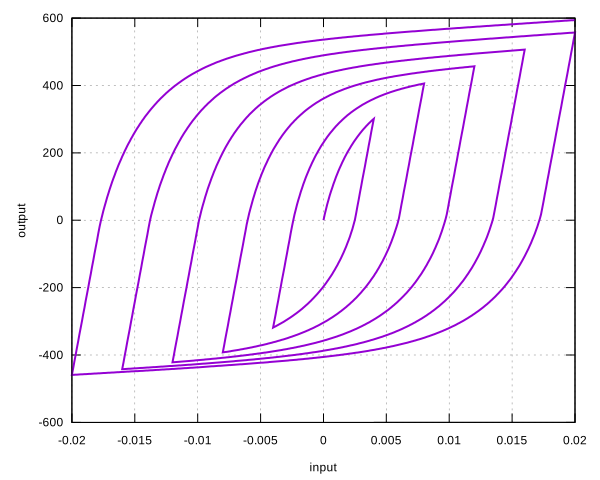
| material SteelBRB 1 2E5 400. 2E3 660. .2 .6 450. .15 .4
materialTest1D 1 1E-4 40 80 120 160 200 240 280 320 360 400 400
|
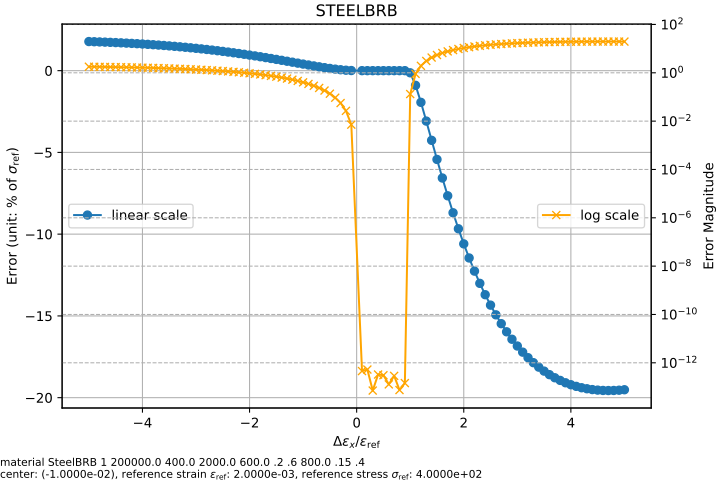
Accuracy
| Python |
|---|
| from plugins import ErrorLine
# note: the dependency `ErrorLine` can be found in the following link
# https://github.com/TLCFEM/suanPan-manual/blob/dev/plugins/scripts/ErrorLine.py
young_modulus = 2e5
yield_stress = 4e2
hardening_ratio = 0.01
with ErrorLine(
f"material SteelBRB 1 {young_modulus} {yield_stress} {hardening_ratio * young_modulus} {1.5 * yield_stress} .2 .6 {2 * yield_stress} .15 .4",
ref_strain=yield_stress / young_modulus,
ref_stress=yield_stress,
) as error_map:
error_map.contour("steelbrb", center=-5, size=5, type={"abs"})
|