SimpleSand
A Simple Sand Model
The continuum mechanics based sign convention (tension is positive) is used for consistency.
The SimpleSand model is a simple sand hardening model that adopts a bounding surface concept.
Readers can also refer to the corresponding section
in Constitutive Modelling Cookbook
for details on the theory.
Syntax
| Text Only |
|---|
| material SimpleSand (1) (2) (3) (4) (5) (6) (7) (8) (9) (10) (11) (12) (13) [14]
# (1) int, unique material tag
# (2) double, elastic modulus
# (3) double, poissons ratio
# (4) double, m, size of yield surface
# (5) double, A, dilatancy related parameter, often negative
# (6) double, h, dilatancy related hardening parameter
# (7) double, alpha_c, critical alpha
# (8) double, n_b, bounding surface evolution parameter
# (9) double, n_d, dilatancy surface evolution parameter
# (10) double, v_c, critical specific volume
# (11) double, p_c, critical hydrostatic stress, should be negative
# (12) double, lambda_c, the slope of critical state line
# (13) double, v_0, initial specific volume
# [14] double, density, default: 0.0
|
Theory
Critical State
The state parameter is defined as
\[
\psi=v-v_c+\lambda_c\ln\left(\dfrac{p}{p_c}\right)
\]
The specific volume can be expressed in terms of strain,
\[
v=v_0\left(1+\mathrm{tr}~\varepsilon\right).
\]
Thus, the bounding surface and dilatancy surface can be defined to evolve with \(\psi\),
\[
\alpha^b=\alpha^c\exp\left(-n^b\psi\right),\qquad \alpha^d=\alpha^c\exp\left(n^d\psi\right),
\]
where \(\alpha^c\) is the initial size of surfaces.
Yield Surface
The following wedge-like function is chosen to be the yield surface,
\[
F=|s+p\alpha|+mp,
\]
where \(s\) is the deviatoric stress, \(p\) is the hydrostatic stress, \(\alpha\) is the back stress ratio and \(m\) is
a constant that controls the size of the wedge.
The following is a visualization of the yield surface in the \(p-q\) plane.
Flow Rule
A non-associated flow rule is defined.
\[
\Delta\varepsilon^p=\Delta\gamma{}\left(n+\dfrac{1}{3}DI\right),
\]
where \(n=\dfrac{s+p\alpha}{|s+p\alpha|}\) is a unit tensor, \(I\) is the second order unit tensor and \(D=A\left(
\alpha^d-\alpha:n\right)\) is the dilatancy parameter.
Note due to the change of sign convention, a negative \(D\) leads to contractive response, thus \(A\) often needs to be
negative.
Hardening Rule
The evolution of \(\alpha\) is similar to the Armstrong-Frederick hardening law.
\[
\Delta\alpha=\Delta\gamma{}h\left(\alpha^bn-\alpha\right),
\]
where \(h\) is a constant that controls the speed of hardening.
Example
Please refer to triaxial-compression-of-sand.
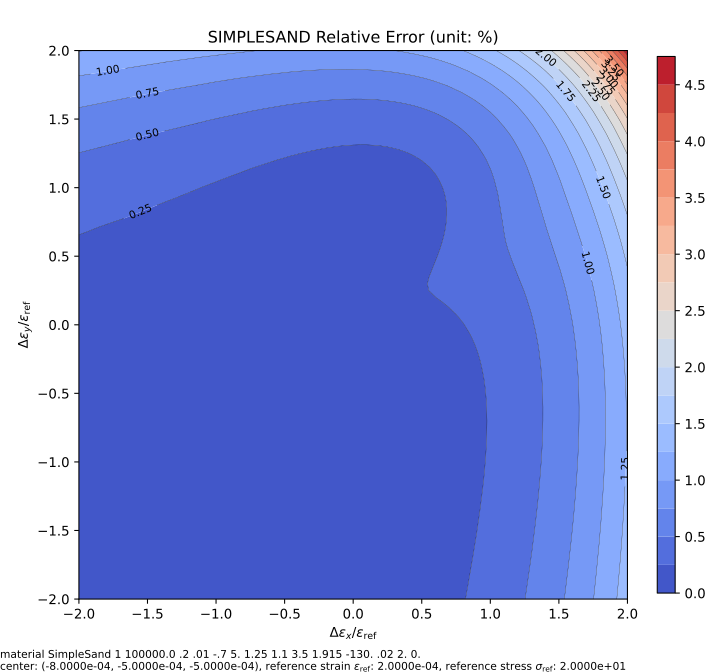
Iso-error Map
The following example iso-error maps are obtained via the following script.
| Python |
|---|
| from plugins import ErrorMap
# note: the dependency `ErrorMap` can be found in the following link
# https://github.com/TLCFEM/suanPan-manual/blob/dev/plugins/scripts/ErrorMap.py
young_modulus = 1e5
ref_stress = 20
with ErrorMap(
f"material SimpleSand 1 {young_modulus} .2 .01 -.7 5. 1.25 1.1 3.5 1.915 -130. .02 2. 0.",
ref_strain=ref_stress / young_modulus,
ref_stress=ref_stress,
contour_samples=40,
) as error_map:
error_map.contour(
"simple.sand.uniaxial", center=(-4, -2.5, -2.5), size=2, type="rel"
)
|